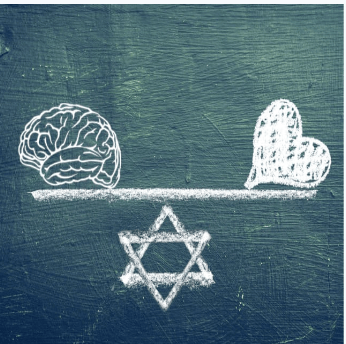
| We al long for inner peace, yet often inner peace and balance elude us. Some reasons are societal – one public outrage after another flooding the zone with hate, war, corruption and more. Other reasons are intensely personal – challenges we face, hurts we carry, thoughts that don’t stop. Unless we get real about the tug of war and peace that rages within each of us – the ever-shifting tug between head and heart, our human need for purpose, and our tools to modulate challenge into meaning, we cannot hope to build back our capacity for healthy balance in our lives. Kol Nidre is about exactly that. |
“Instructions for having a soul: Take it out in the rain sometimes. It has vast, invisible wings that gather dirt and need rinsing.”
These words by poet Joe Fasano aptly depict our purpose this Yom Kippur: to cleanse our souls and, on this year’s theme, renew our balance.
Yom Kippur has a certain pace. Kol Nidre ushers us through gates of forgiveness. Then we take a whole day to catch up, open up, own up and wake up. Introspection and confession, over and over, aim to soften our inner defenses until finally, maybe despite ourselves, we can let go, let in more light, and emerge renewed and rebalanced.
During these precious hours, hearts and minds will wrestle. The mind knows how we try to be good but the heart lags behind, freighted by pain, impulsivity, insecurity and guilt. Or the heart knows but the mind lags behind, straining to make sense of a senseless, hurting world.
Whatever your way, a battle between head and heart, a tug of war and peace, is built into Yom Kippur and the life balance we crave. That’s our subject this evening – not the physical wars of headline news, but our inner battle for genuine and worthy peace of spirit. On this sacred night, we examine how we lose balance, the impulses that jolt us, and ways to help us cultivate truly worthy inner peace.
The 18″ between head and heart is the longest 18″ in the world. This gap is why we’re not always our best selves and don’t fully live our values. This 18″ might be a million miles for what we humans forget. Think about it: if every head and heart really got that all of us are children of one awesome God, all endowed by our Creator with certain inalienable rights, in a flash there’d be no antisemitism, racism, misogyny, homophobia, poverty, corruption, abuse or grudges.
Rarely do we seem to live in that world. Spiritual ideals take a backseat to getting ahead or just holding our own. It’s why tikkun olam (repairing the world) is such a key Jewish calling – not just giving charity but literally repairing the structural imbalances of life.
ikkun is so especially important now because modernity feeds on imbalance, bombards us with imbalance, stokes our deep-seated fears and inadequacies to get us to click, buy and vote. Get thinner! (Never mind the perfected potato chip that hooks us to eat more!) Buy this new thing! Your woes are their fault! (Group blame is old school: we Jews have been go-to scapegoats for centuries.)
But total placidity all the time can be its own kind of problem. Total balance all the time rarely is what it seems to be: more often it’s avoidance and disengagement masquerading as peace and balance.
When I began my two-year clergy fellowship with the Institute for Jewish Spirituality, at first I thought the most inner peace I could get was to detach and bliss out – which was great, but it wasn’t real. In time, thoughts disturbed me – and try telling the mind not to think.
Let’s try it for 10 seconds. Everyone ready? Do not think of a white bear. Go.

The mind is wired to think, so suppression can’t work for long – not with white bears, and not with the emotional bears of our pain, insecurity, impulsivity and guilt – which is why they keep coming back to mind. Spiritual tools like prayer, learning, introspection, meditation, yoga and service aren’t anesthesia to put us to sleep. They’re to wake us up, to strengthen balanced presence to all that life can throw at us.
At the highest spiritual level, already tonight we are forgiven – even if we have not yet fully earned it. None of us ever can fully earn it. We do our best, and supernal forgiveness is better than our best, a gift of love that never can be fully earned. Yom Kippur tries to help us feel it and, in response, call forward our very best selves to meet it.
We start by opening the heart to feeling, even if the mind wants to do something else, so please try something with me.
Put a hand on your heart. If it’s comfortable, close your eyes or just stay here with me. Bring up someone you love who has suffered. You love them, so you want them to feel at ease and safe. Whisper to them now, “Dear one, may you be at ease; may you feel safe.” Try it a few times, each more truly and sweetly. “Dear one, may you be….”
Now switch hands. With your other hand on your heart, whisper to yourself a term of endearment – sweetie, beloved, whatever feels best. Whisper to yourself, “May you be at ease; may you feel safe.” Try it a few times, each more truly and sweetly. “May you be….”
Did one of those feel easier? Most of us are better at feeling for others than for ourselves. If that’s you, then you might use this Yom Kippur to sense why and keep trying to reach your own heart.
None of this is to say we always should immerse in our stuff. Yom Kippur is for immersion, and constant immersion all but ensures imbalance. Soon after the October 7 attacks, when Israel and most of us tuned to the news nonstop, Israeli psychologists and military chiefs made a rare joint statement. They urged us not to stay glued to the news. Re-hashing traumatic images, they urged, would only add to trauma and help terror win. But do stay informed, they said: read every day, read instead of watch, stop for a while, then come back.
People who heeded this advice were healthier and no less well informed – yet most did not heed this advice. Why not? And why did most of us tune in nonstop throughout covid, after October 7, and amidst other calamities? Why did we become such junkies?
One reason is biology: hyper-arousal generates adrenaline that craves a next hit. An odd FOMO (fear of missing out) is why we fixate on bad news and doom-scroll on social media: we get hits but not better informed. Another reason is psychology: subconsciously we figure that, if we really care (for instance, if we care about Israel), then we’ll watch nonstop – an odd kind of loyalty. But merely watching the show does not help change the story.
If you feel like one public outrage follows fast on the heels of another, you’re not alone. Many of you have told me that you feel this way (I feel it, too). It floods the zone so we chase the latest awful, or exhaust ourselves trying, or go numb or disengage. We can’t tune out without giving in, but we also can’t throw ourselves at every dumpster fire without getting burned. Balance lies in between: choose issues that matter to you, focus on those, do something about those, and let the others receive a softer peripheral vision.
Jewish spirituality teaches much the same about ourselves. We can’t improve all our flaws at the same time: instead, we can focus on one trait at a time for a discrete period. This Yom Kippur, maybe focus on one or two things about yourself that feel most imbalanced. Maybe your boundaries are too strong, or too weak; maybe you’re too proud to face mistakes, or so self-critical that you’re too beaten down to try. Choose a few, and give the others a softer peripheral vision.
You know yourself, so choose. Just please choose something not just because it’s Yom Kippur, but because passivity can be as harmful as hyper-arousal and perpetual immersion in brokenness.
Starting in the 1950s, animal behavioralist John Calhoun studied this dynamic by creating – get this – rat nirvana. He put four male rats with four female rats and gave them limitless food, limitless water, the softest down nesting, perfect temperature and ample space. It was rat heaven. Pampered by life, at first the rats did what rats do: eight rats became 80 became hundreds, then around 2,500. Months later, they all died, even though they were physically healthy. Calhoun repeated this experiment 25 times – 25 rat nirvanas – all with the same result.
 |  |
 |  |
Calhoun studied each failed colony. Life on Easy Street made the rats self-absorbed: they groomed only themselves, so immersed in their own beauty that Calhoun called them “the beautiful ones.” Then they began fighting for no reason. Social bonds frayed. The violence deterred breeding. The few rats that had pups stopped caring for them. A too-easy life taught them to strive for nothing, do nothing. Calhoun called it “spiritual death,” and literal death soon followed.
Calhoun’s focus wasn’t rats but humans. A too-easy life, he feared, could hobble humanity. Sociologists rejected him – but now decades later, now we know a bit more. Kids raised in extreme wealth are disproportionately likely to languish, use drugs and get in trouble. Colleges report dropout spikes after just two weeks, because it’s hard. Employers report that today’s young adults are less effective at work and less resilient. Retirees without purpose tend to falter.

Turns out that we need challenges at all phases of life to keep teaching us how to navigate life, and we need purpose to thrive. Too much challenge and we can become hard-hearted, brittle or numb. Too little, and we risk languishing like Calhoun’s rats.
Of course, we humans are not rats. But if rats need challenge in order to live, all the more do we. Socrates was right 2,400 years ago: “An unexamined life is not worth living.” Torah was right 3,400 years ago: “Answer your souls.” Live each day knowing that Yom Kippur will come and say, ועניתם את נפשותיכם / “Answer your souls.” Torah pleads with us, “Choose life, that you may live.” Choose a life of inner rigor, demanding that we step up. Only then can we live a balanced life and not be passive victims to whatever an unbalanced world throws at us.
As it happens, right now you are with some of the best ways to step up and invest in balance – each other, community, peoplehood. When Calhoun’s rats stopped tending each other, they had no reason to live. When Cain snidely asked God if he was his brother’s keeper, Cain was no better than a rat, and condemned to wander aimlessly. We are part of each other’s purpose in life – full stop.
It is partly for the quality and balance of our own lives that we turn inward, choosing the challenge of answering our souls, and taking the sometimes difficult path of owning up and changing our ways. If we crave Easy Street so much that we shy away from this inner call to challenge, then we will languish. And it is partly for others that we heed this clarion call – for people we love, our friends, our neighbors, our community. We are their keepers. You are their keepers.
Perhaps we feel like we’ve already done our part. We’re retired, we want it easy, we earned it. Yes! And we recall that an unexamined life is not worth living – not at any age. We recall that elders without purpose and challenge are more likely to falter. And we recall, too, that as we mature we become more adept in this purpose to “answer our souls,” to balance the tug of head and heart, because over time we generally become more patient and less impulsive. Maybe youth is wasted on the young; for certain, spirituality is for adults – and especially for elders.
Judaism’s most respected sage, Rabbi Hillel, did not begin his Jewish spiritual journey until late in life. Even at age 40 – in today’s math, well into his 60s – he had zero background and didn’t know the Hebrew alphabet. But life taught him inner focus, enough to deeply observe how water can slowly wear down a stone, and he saw that spirituality can work just that way. How telling that the sage with the best reputation in Judaism started late in life.
Rabbi Hillel comes to remind us that we always can: it’s never too late. Rev. Dr. Martin Luther King said much the same thing: “If you can’t fly, then run. If you can’t run, then walk. If you can’t walk, then crawl. But whatever you do, you have to keep moving.” True and worthy peace of spirit is never to be found by becoming passive, or pretending away deep truth, or blithely accepting the unacceptable.
And therefore, my friends, I bless each and every one of us with perhaps an odd kind of Yom Kippur blessing. Some might say, “May you have an easy fast,” or “May you have an easy Yom Kippur.”
I do not wish for you an easy Yom Kippur. Our lives, our souls, our beloveds, our community, our true sense of balance and our most worthy inner peace all are too important to have an easy Yom Kippur. Instead, in the words of my friend Rabbi Adam Greenwald:
I wish you a Yom Kippur in which you feel something, even if it’s just for 15 minutes, or five, or one.
In which the melody of Kol Nidre stays not just in your ears, but in your heart, your soul, your guts.
In which you feel the full ache of Yizkor – for your loved ones, for our people, for the world with too much grief in it.
In which you hear and accept the prophet Isaiah’s challenge that all this fasting and praying doesn’t mean a thing unless coupled with a commitment to walking out of here to radiate out light in the dark.
In which you look inside yourself and see yourself and your life as worthy of the hard work it’ll take to be better tomorrow than you were yesterday….
I hope you take care of yourself: take a break when you need to, close the book or close your eyes when you need to, even eat if your body requires it. Authentically taking care of our worthy needs is holy.
I hope at some point you dance. I hope at some point you turn to silence. I hope the final shofar blast stays in your ears.
I don’t wish you an easy Yom Kippur. But I wish you a day that is something so much better, much more important, than easy. I wish you a day in which your soul comes alive, in which anything is possible, for you and for us all.
“Instructions for having a soul: Take it out in the rain sometimes. It has vast, invisible wings that gather dirt and need rinsing.”
May this Yom Kippur cleanse us, smash complacency, inspire us to re-balance our lives, and bring at last a worthy peace to us and our broken world. Shanah tovah.

