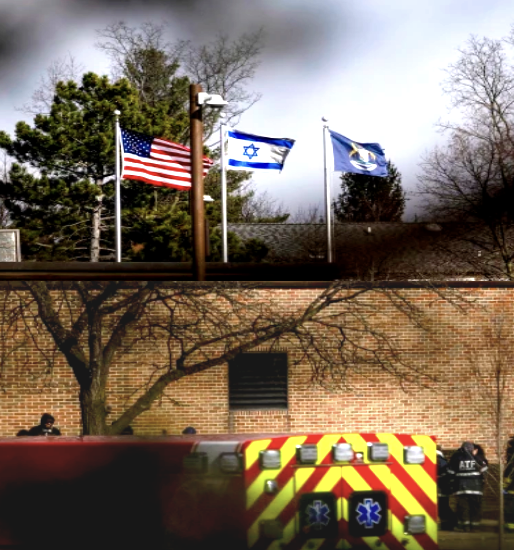
On Erev Rosh Hashanah, we began limbering up to our holiday theme, renewing balance, with an expansive spiritual vision. Today we aim that vision at the heartland, front line of grief and joy.
As antisemitism and even antisemitic violence rear their ugly heads, easy talk won’t help. For us to maintain a vibrant balance worthy of us and our best selves, we need to answer antisemitism with a pro-semitism we experience in our bones, in our hearts and minds.
We have amazing superpower tools. What if we actually used them?
By Rabbi David Evan Markus
Rosh Hashanah 5787
Shanah tovah. I hope Jewish Year 5787 dawns bright for you.
Last night we began limbering up to our holiday theme: renewing balance. We saw how two things so different that they should not be able to coexist both can be true. The world is a mess, and we have boundless potential. We are dust and ashes, and the world was made for us. Our goal is a healthy, dynamic balance for all of it.
Today we aim this vision at the heartland – front line of grief and joy, love and hate, and what they might portend for us as a people.
Imagine that two friends are with you. One has suffered a recent tragedy – a death, a house fire, the shriveling of a lifelong dream. The other celebrates – a wedding, a cure, a promotion, winning the lottery.
Take a moment to feel with each friend. Each of them immerses in an experience independent of the other and whole in itself. The joy of Friend #2 is total, and the grief of Friend #1 is total. Can we totally celebrate with Friend #2, and totally grieve with Friend #1?
I hope so, because collectively our people are both Friend #1 and Friend #2. Collectively we embody both tragedy and triumph. If we can’t fully feel both and move deftly among them, then our people face an existential threat greater than everything else swirling around us.
Please meet my friend Jennifer Kaluzny.
Jennifer lives in America’s heartland northwest of Detroit. She is a rabbi at Temple Israel in West Bloomfield, Michigan, the largest Reform synagogue in the United States.
You’ve heard of her, even if you don’t know it.

Jennifer was in the news exactly six months ago, on March 12, 2026, when a terrorist crashed a car full of fireworks and gasoline into Temple Israel.
In the resulting fire, miraculously only the terrorist died. The car wedged into a hallway: otherwise, it would have rammed a room full of kids. The terrorist opened fire and hit a security guard who was 6’6″ tall: a shorter security guard would have died. The terrorist targeted Temple Israel because its name included the word “Israel” and he figured Israelis would be there.
Only today, exactly six months later, did the building reopen.
Ordinarily I might not share this story on Shabbat, our weekly day of rest and wholeness. In that spirit, I will not show photos that Jennifer sent me. But there is a Rosh Hashanah aspect to this story, and a Shabbat aspect, and both are worth sharing precisely today.
Scheduled for just hours after the attack were two lifecycle celebrations – two b’nei mitzvah. Would they happen, and if so, how?
Grief and joy, hate and love. How to hold both fully? How to live fully amidst both?
We live in an era of surging antisemitism and Islamophobia, anti-LGBT bigotry and xenophobic racism, anger, cruelty, and exhaustion from it all.
Each of us knew all that before coming here today. Each of us knew all that before meeting my friend Jennifer.
Within minutes after the attack, 60 law enforcement agencies and fire departments responded. They set up a two-mile exclusion perimeter. Parents ditched their cars and ran toward the synagogue, frantic to find their children. Meanwhile, the building was evacuated. Unsure if more danger lurked outside, some were hurried to nearby churches, others to nearby homes. The first hours were chaos.
And, two families were scheduled to celebrate. An Iraqi Christian community pitched in for Shabbat, a country club for a bar mitzvah, another synagogue for a bat mitzvah. Countless volunteers and a different kind of chaos later, they celebrated on time and danced with joy.
I asked Jennifer how she and Temple Israel managed it. What was it like to comfort scared parents, staff and injured first responders, and visibly celebrate, all on the same day? What was it like to feel disgust and fury at the soul-rending stupidity of collective hate, sorrow for the building damage and our broken world, dizzying complexity about the Mideast, and total pride and joy in 13-year-old changelings who eked out Torah portions with voices cracking?
Jennifer is a naturally gregarious person. She had a lot to say about each of those individual things. But to my question of how she and they did it all, fully living both joy and “oy,” Jennifer went quiet.
I sensed her going into herself, searching for a response. She stayed quiet awhile. When she did speak, her words were simple: “It’s what we do. It’s what we’ve always done. We have no choice.”
We talked about how there’s more room in a broken heart – a Jewish nugget of wisdom that tradition refined from experience. We talked about Fiddler on the Roof and why that image is so fitting. The fiddler didn’t fiddle unaware or uncaring while Anatevka burned. The fiddler fiddled to express it all, because life includes both burning and dancing. Music helps us dance and, sometimes, endure burning.
In the awesome wisdom of Viktor Frankl, psychologist and survivor of Auschwitz, “That which gives light must endure burning” (Man’s Search for Meaning).
Temple Israel celebrated that night not despite the attack but exactly amidst it – fully feeling shock, sadness, imbalance and all the rest. Yet they would not go small or go home. The more hate, the more love. The more darkness, the more light.
So too in the State of Israel after the October 7 attacks – over 1,000 funerals, each one a national grief. And Israelis still loved, got married, celebrated, sat in cafes, played soccer, argued about falafel, and lived loud and proud. Israelis would agree with Jennifer: “It’s what we do. It’s what we’ve always done. We have no choice.”

Amidst it all, hate and fear all around, never becoming calcified or brittle, Israel consistently ranks among the 10 happiest nations on earth. The World Happiness Report, a project of Oxford University, the United Nations and the Gallup polling organization, ranks Israel #8 in global happiness behind only Scandinavian countries and Costa Rica. It’s not that the October 7 attacks didn’t land hard: they surely did. In the “Before Times,” Israel ranked #4. (The U.S. ranks #23.) And it’s not that Israelis are blind or numb. Per capita, there are more social workers and psychologists in Israel than most anywhere else.

(Next month, our Book Club will discuss Rachel Goldberg-Polin‘s extraordinary book, When We See You Again, chronicling the journey of an October 7 mom through grief to meaning. More about that later.)
And it’s certainly not that my friend Jennifer was unaffected by the Temple Israel attack. For months her backpack was her office. She was nauseous. Her body shook. Community needs were so great that a nonprofit set up a trauma center. Torah scrolls had to be restored to not smell like smoke. Every day was a struggle; many still are.
Yet even so – for Jennifer and Temple Israel and the State of Israel – something more is afoot than making do or muddling through. It’s worth figuring out what, and taking it on in our own lives, our own communities, and our country – especially in these unbalanced times.
Jews have been at this for so long that Talmud (B.T. Ketubot 17a) records an illuminating 1,600-year-old spin on it. A funeral procession and wedding procession reach a crossroads at the same time. Before traffic lights, which had the right of way? Jewish funerals happen fast, but tradition’s answer was the wedding processional. Why? Because life, hope and heart-expanding joy always come first – and not just partly. Totally. Full throttle. All in.
Jews and Israelis are hardly alone in preaching this response to hardship. African-American life has seen profound hate, degradation and death. Have you ever attended a Black Baptist or AME church? Often the vitality and joy are immense – alive, organic, contagious.
Amidst all the hardship, Jennifer insisted, “not one family let its joy be diminished. It was an act of defiance. It was like, ‘You tried to extinguish the Jewish spirit, and you failed.'” Jennifer shared that it taught her that we are stronger than we know, community really does matter, people can adapt, Judaism is powerful, and power is portable.
So it was after the Romans destroyed the Temple in Jerusalem, Israel. So it was after March 12 at Michigan’s Temple Israel. So it was after incidents on August 14 at Central Synagogue in New York with my friend Andrew Mandel as rabbi, and on August 17 at Kol HaNeshama in Jerusalem with my friend Oded Mazor as rabbi.

“To be a Jew,” taught Rabbi Jonathan Sacks, “is to be an agent of hope in a world serially threatened by despair. Every ritual, every element of Jewish law, is a protest against escapism, resignation or the blind acceptance of fate. Judaism is a sustained struggle, the greatest ever known, against a world that is, in the name of the world that could be, should be, but is not yet.”
It’s a difficult vocation we’re all in. Three years ago I stood at this pulpit and asked us, “If we were hiring Judaism to do a job, what job would we hire Judaism to do?”
What job? The answer, my friends, is exactly this.
Just weeks ago, a Board of Rabbis statement began: “There was a time when the words ‘Never Again’ were followed by an exclamation mark. Today, in the face of rising antisemitism, hatred and violence, they too often seem to be followed by a question mark.”
“We must reject the culture of hatred” – a culture that loves only some neighbors like ourselves, or accepts for ourselves anything less just to get along. We must reject that culture anywhere it appears and whomever it targets. Yes!
And such words are as easy to say as any words – Jennifer’s words, Jonathan Sacks’ words, or my words.
But this isn’t about words. This is about core commitments, in our own heartland, that change our choices – that reshape what we do with our day, that redirect the weeks and months that become years and decades. It’s about a Jewish life that cultivates joy and not just talks about it, that builds healthy resilience and not just talks about it, that fully opens hearts to fully celebrate and fully mourn – not just talk.
Perhaps life has taught us that full-throttle emotion is unsafe, or not in fashion. Perhaps we dull our emotions to weather tough times, because they hurt and we’d rather not fully feel them. Some won’t put up a mezuzah, or took down a mezuzah. To stay safe, we go small.
Jennifer and Temple Israel and the State of Israel talk plenty about antisemitism… and so must we. But what if we also invest more in pro-semitism? If we paid half the attention to pro-semitism that we pay to antisemitism, how different we would be!
What if we lean more into the great good that a full-hearted, alive Judaism can do for re-balancing us, community and country – as a counter-weight to all the antisemitism and all the other isms?
What if we lean more into celebration even if inconvenient or at first ambivalent? Joy and hope are disciplines – not accidents, or beyond our control, or the stuff of wishful thinking.
What if we lean more into Shabbat? – not because I say so or just because Torah says so, but because the practice of making a weekly shift helps keep us emotionally limber so that we can shift.
What if we lean more into learning? Holding complexity helps us ballast storm tides, and spiritual learning is full of inspiration and beauty that can lift us above the mundane and the muck.
What if we lean more into blessing and prayer, whether written down or spontaneous from the heart? As any psychologist will say, the whole spectrum of expression – gratitude, love, yearning, doubt, fear and all the rest – is essential to human flourishing.
What if we lean more into the Jewish spirit of tikkun olam? As any psychologist will say, altruism and giving help us feel rich and become rich in the ways that most matter to the quality of our lives.
These are Judaism’s superpowers, what we hire Judaism to do, the reason the fiddler fiddled and stayed balanced on a rickety roof. They are the secret to Israel’s dazzling successes and globe-leading happiness amidst such tragedy, and how Temple Israel celebrated after an attack. They are how and why Judaism survived until now.
Of course, they’re not the only way. I believe with total faith and cellular knowing that each wisdom tradition encodes its own paths to resilience, balance, flourishing and transcendence. I believe with total faith and cellular knowing that each wisdom tradition ultimately shares similar purpose and language for a nearly unbearable lightness of being.
And I believe with total faith and cellular knowing that each of them aims to help us experience – not just say or think – what Ralph Waldo Emerson meant when he said, “What lies behind us, and what lies before us, are tiny matters compared to what lies within us.”
What lies within us is a great light that we need and the world needs – especially now. It does us and the world no good to keep it small or play it safe. If there is darkness, bring light. If there is hate, love so big that hate can’t touch it. If there is antisemitism, bring pro-semitism. If hope or resilience falters, reach into our 3,500-year toolbox not just for quick boosts but also for tried-and-true superpowers. If Temple Israel could grieve and dance, then so can we. So must we.
May 5787 be that year of cellular, big-hearted, ethical and loving collective rebalancing for us, for all we hold dear, and for all Israel.
 David Evan Markus