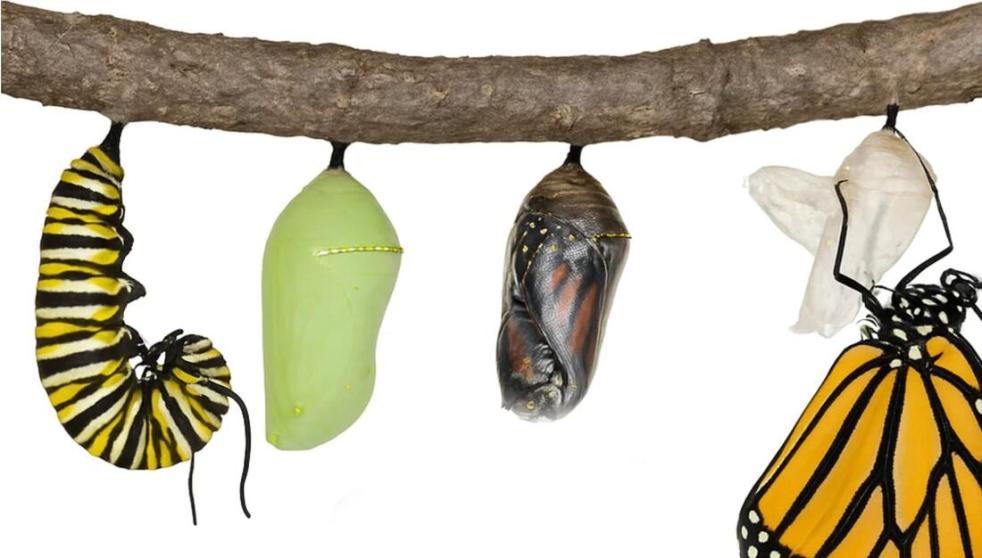
| We’re not quite butterflies, but we all tend to have times when we withdraw and re-emerge. Almost always, there’s a reason. And almost always, we emerge changed. It’s worth paying attention to when, and why. |
By Rabbi David Evan Markus
Hayyei Sarah 5787 (2026)
If we pay attention, we’re likely to find times that we pull back from our fullest engagement in outside life, and then re-emerge. Whether it’s routine stress, overwhelm, illness, trauma, grief, depression or something else, our insides withdraw us from the outside.
And then, in time, we re-emerge. (If we don’t re-emerge, that’s a sign that we might need support. If that you, please reach to me.)
When we re-emerge, almost always we are changed. With benefit of 20/20 hindsight, we can look back and see why – what changed in us, what got transformed, maybe what got healed. And it’s always worth paying attention to the change, the transformation: however subtle, it will tell us something important about our lives.
I’ve seen these truths in so many people, and in myself. And I thought of it instantly when I encountered a midrash on this week’s Torah portion.
We call this portion Hayyei Sarah, means “Life of Sarah,” though it starts with Sarah’s death and Avraham’s arrangements for her burial. It then leads into encounters that put their son Isaac on his own life path.
We haven’t heard about Isaac since the Akeidah (Binding of Isaac), when Avraham believed he heard God tell him to sacrifice his son. It’s as if Isaac withdrew from Torah altogether.
Years later, Avraham sent his servant to find a wife for Isaac. As servant returns with Rebecca, we encounter Isaac (Gen. 24:62-63)
| וְיִצְחָק֙ בָּ֣א מִבּ֔וֹא בְּאֵ֥ר לַחַ֖י רֹאִ֑י וְה֥וּא יוֹשֵׁ֖ב בְּאֶ֥רֶץ הַנֶּֽגֶב׃ וַיֵּצֵ֥א יִצְחָ֛ק לָשׂ֥וּחַ בַּשָּׂדֶ֖ה לִפְנ֣וֹת עָ֑רֶב וַיִּשָּׂ֤א עֵינָיו֙ וַיַּ֔רְא וְהִנֵּ֥ה גְמַלִּ֖ים בָּאִֽים׃ | Isaac had just come from Be’er-l’hai-roi, and he was sitting in the land of the Negev. Isaac went out discursing in the field at the turn of evening: looking up, he saw camels approaching. |
What Torah tells us is that Isaac was in a place called
Be’er-lahai-roi, “Well of the Life that sees me,” and he was “discursing” (in discussion or meditation) in late afternoon. This moment is the textual source of minhah – afternoon spiritual practice, or the pause that refreshes.
But where was Isaac all this time? One important midrash holds that for three years, Isaac had withdrawn all the way back to the Garden of Eden (Hizkuni, Gen. 24:63), brought there by God to heal from his trauma of the Akeidah.
And only because of that – only because he withdrew and returned – could the rest of the story unfold. Only then could he love Rebecca, and only then could he find comfort after the death of his mother, Sarah (Gen. 24:67). Otherwise, trauma would have gotten “stuck” and he would be unable to fully love and move forward with life come what may.
Isaac’s time “away” wasn’t an escape: it was a purposeful time away to transform, no less than the caterpillar that weaves a chrysalis and emerges as a butterfly.
Isaac entered his chrysalis traumatized, and emerged ready to love and life anew. Had Isaac not entered his chrysalis, his story would have stayed stuck in his past. And we as a people wouldn’t have a story at all, for only through Jacob, the son Isaac and Rebecca would have, would we come to exist at all. Isaac needed to heal for us to exist.
By the same token, had Isaac not come out of his chrysalis, there’d be much the same result. There’d be no love, no Rachel, no Jacob and no us. Isaac had to return for there to be a future.
We all need times to pull back. If we don’t take them, we might not heal from whatever real or imagined hurt shrunk us or shrunk our capacity to love fully. But if we stay away, there can be no real future.
The middle path – with a connection to the Sacred, even if not a Garden of Eden – is our only way forward.

