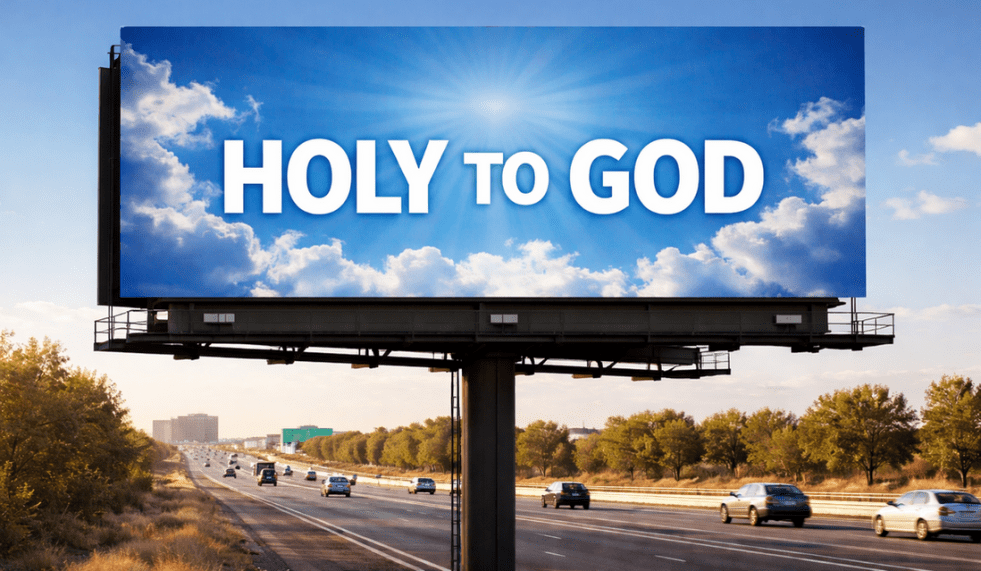
| Know it or not, each of us wears a sign on our forehead. It tells others who we are. Even more, it tells others who they are. We’d all be far better if we remembered the sign we wear on our foreheads. |
By Rabbi David Evan Markus
Tetzaveh 5786 (2026)
On my recent travels to California and Florida, the most prominent highway billboards were lawyer advertisements. Most were personal-injury attorneys looking to highways for business (and hopefully not contributing to accidents as fast-driving motorists diverted their gaze).
Thousands of years earlier in this week’s Torah portion, Aaron, Moses’ brother, became Kohen Gadol (High Priest) with an outfit that set him apart. On Aaron’s vestments would be Torah’s first advertisement (Exodus 28:36-38):
| וְעָשִׂ֥יתָ צִּ֖יץ זָהָ֣ב טָה֑וֹר וּפִתַּחְתָּ֤ עָלָיו֙ פִּתּוּחֵ֣י חֹתָ֔ם קֹ֖דֶשׁ לַֽיהו”ה׃ וְשַׂמְתָּ֤ אֹתוֹ֙ עַל־פְּתִ֣יל תְּכֵ֔לֶת וְהָיָ֖ה עַל־הַמִּצְנָ֑פֶת אֶל־מ֥וּל פְּנֵֽי־מִּצְנֶ֖פֶת יִהְיֶֽה׃ וְהָיָה֮ עַל־מֵ֣צַח אַהֲרֹן֒ … תָּמִ֔יד לְרָצ֥וֹן לָהֶ֖ם לִפְנֵ֥י יהו׳׳ה׃ | Make a frontlet of pure gold and engrave on it the seal inscription: “Holy to YHVH.” Put it on a cord of blue so that it will stay on the headdress: it will remain on the front of the headdress. It will be on Aaron’s forehead … always, to win them favor before YHVH. |
Imagine someone walking around with “Holy to YHVH” on their forehead. That was Aaron. But why?
The most obvious explanation was that Aaron’s “Holy to YHVH” was a nametag – a description of his role, and a reminder to himself about what his role entailed. But our ancestors sensed that something far more profound and revolutionary was afoot.
At a time when religion’s role in society was changing, Bahyah ben Asher ibn Halawa (1255-1340) taught that Aaron was no more inherently holy than everyone else. Rather, in his role he was to be a reminder and hopefully an exemplar of principles and callings applicable to all.
Put another way, Aaron’s “Holy to YHVH” wasn’t a nametag. It was a billboard, advertising to people not who he was but rather who they were – or, at least, who they were supposed to be.
Judaism’s “High Priest” model has faded. In modern Jewish life, families descended from the ancient Kohenic line (often with last names Cohen, Cooper, Cowan, Croen, Kagan, Kalman, Kaplan, Kippurt, Kogan, etc.) have vestigial ceremonial roles. Mostly, however, the ancient role of High Priest (literally “high servant”) divides among clergy, lay leaders (Board members) and the whole community itself.
Whoever you are, imagine that you wear a “Holy to YHVH” billboard on your forehead Maybe it reminds you who you are, though unless you have eyes in front of your head, you yourself can’t see it. But it’s there nonetheless, for others to see.
How you act – how each of us acts – will shape how people read the words on our foreheads. Perhaps by how we behave, we can remind people that they are “Holy to YHVH” and inspire them to act like it.
And as we do – person to person, heart to heart, we can fulfill the wisdom of Proverbs 27:19: “As water [reflects] face to face, so the heart from person to person”
And thereby change the world.
 David Evan Markus