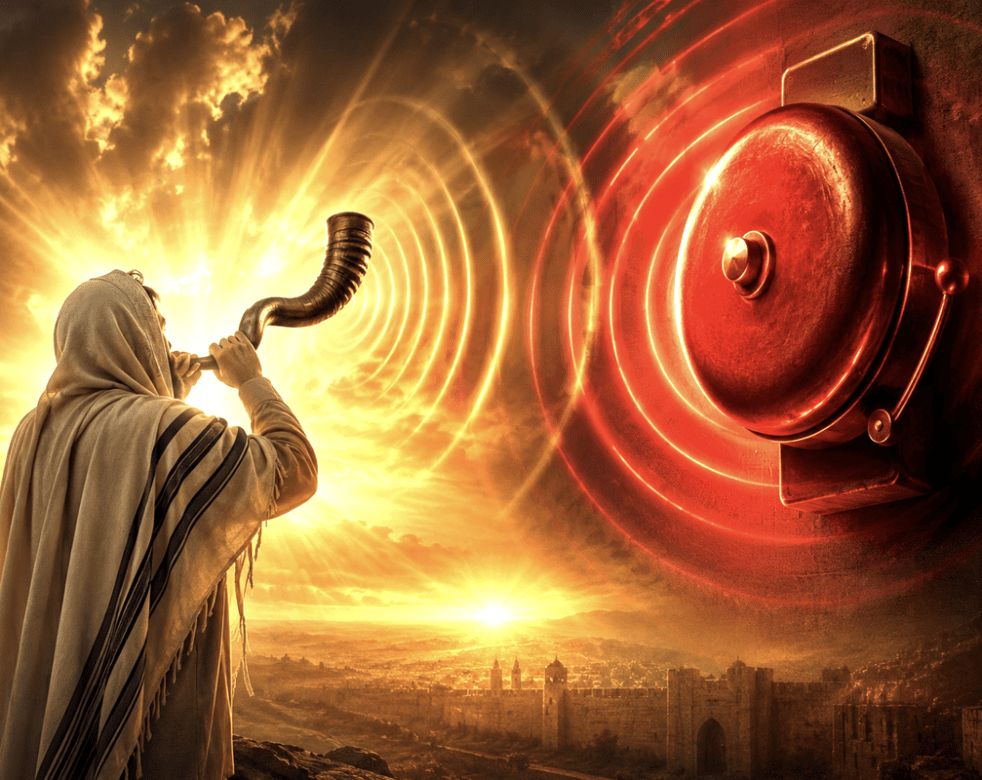
| This week marks 10 weeks until Rosh Hashanah. Torah, always uncannily on time, reminds us this week about Rosh Hashanah and the shofar. For a practice so symbolic, so core, so cellular in resonance and impact, it’s odd that Torah does not tell us why we connect Rosh Hashanah with shofar. And Torah also left it to tradition, 2,000 years ago, to not blow shofar on Shabbat. Why? The answers have to do with alarms. |

By Rabbi David Evan Markus
Parashat Pinhas 5786 (2026)
This week marks 10 weeks until Rosh Hashanah. Exactly on time (and long before we feel ready), Torah’s weekly cycle has begun dropping High Holy Day hints to begin rousing us.
This week’s portion recaps the Jewish spiritual calendar, including Torah’s fateful words that on Rosh Hashanah we “observe a sacred occasion: [we] do no form of labor – it is a day for the teru’ah” call of the shofar (Numbers 29:1).
Teru’ah is one of the shofar’s three central sound patterns – the one with nine fast piercing blasts. But the Hebrew word teru’ah (תְּרוּעָה) itself means “alarm.””Alarm” isn’t a word we tend to associate with Rosh Hashanah – but it’s right there and always has been. As it turns out, “alarm” is apt for the deep spirituality of the High Holy Days – if we understand the kind of “alarm” we’re talking about.
In one sense, the shofar is an alarm clock waking us from yearlong sleep. Maimonides put it this way: “It’s as if the shofar is saying, Sleepers: wake from your sleep! Slumberers: rise from your slumber! Search your deeds! Search your souls! Return in repentance! Remember your Creator!” (Mishneh Torah, Hilkhot Teshuvah 3:4).
If you’ve felt a shofar blast in your kishkes, you know intuitively what Maimonides means. An otherworldly sound pierces routine, rivets awareness, triggers memory, softens defenses, and evokes emotion. If at first we’re emotionally or spiritually groggy, if our inner walls grew back since last year, shofar blasts aspire to wake us up and tear walls down.

In another sense, the shofar is a fire alarm. When we hear the wail of a smoke detector, instinctively we do more than pay attention. We know that we must act – and quickly. The stakes are too high to ignore or tarry.
Put simply, a fire alarm is not a mere suggestion or kind invitation. It’s an urgent command: MOVE!
So too with the shofar. We must answer our souls, and urgently. The meaning and quality of our lives turn on it As Plato put it, “An unexamined life is not worth living.” More recently, the idea has been expressed this way:
Annual renewal is necessary if life is to retain its freshness and novelty, [to avoid being] locked in[to] lives [that] seem repetitive and dull. Rosh Hashanah is an opportunity for us to make a quantum leap to a new plateau of sacred consciousness that will inspire our lives for the coming year. To accomplish this, however, we cannot rely only on the words of our prayers, because words carry specific meanings for us that are limited by the knowledge and experiences we have accrued in our lives. In order to break out…, we use the blasts and wails of the shofar, which transcend the confines of verbal language.
Renewing our lives is urgent, so we need more than routine language: we need something beyond language. The shofar alarm’s urgency transcends language and compels us to take leaps – to break free.
Why, then, don’t we traditionally blow shofar on Shabbat? As also occurred in 2023, Rosh Hashanah 2026 begins on Shabbat. We will sound shofar just before we light the Shabbat and festival candles on Erev Rosh Hashanah (this year, September 11), and then again more extensively on Rosh Hashanah Day 2 (this year, September 13) – but not on Shabbat during Rosh Hashanah Day 1 (September 12).
The reason, at its core, is that Shabbat isn’t about alarms.
Shabbat is for gentle reset, delight and celebration. Shabbat isn’t for jolts, urgency or pleading. Shabbat evokes ease and not difficulty, rest and not work. Neither kind of “alarm” – the jolting kind, or the urgent kind – is consistent with Shabbat.
So on Shabbat, instead of hearing the physical shofar blast of alarm, we remember it. Rosh Hashanah is the Day of Remembrance (יוֹם הַזִּיכָּרוֹן / Yom Ha-Zikaron) (Lev. 23:24) partly for this reason. Rather than a physical jolt, on Shabbat we tune in deeply to inner peace, subtlety and nuance – all encoded in the memory and imagination of the shofar (Vayikra Rabbah 29:12; B.T. Rosh Hashanah 29b) for which an alarm might be distracting or overwhelming.
For spiritualists and mystics, it’s an opportunity for a special kind of inner spiritual stillness that, Jewishly speaking, is most easily heard and felt on Shabbat (J.T. Rosh Hashanah 4:1.2). We might even hear the primordial silence from which Creation began when all was Infinite Oneness – the Creation whose anniversary is, yes, Rosh Hashanah.
Zohar, the Book of Splendor, puts it this way (Zohar Addenda, 1:25.195):
| בָּר מְשָׁבְּתָא דְּאִית בֵּיהּ נִיחָא, וְלֵית בֵּיהּ דִּינָא כְּלָל. דְאִתְגַלְיָיא עַתִּיקָא קַדִּישָׁא חֵידוּ וְטָבָאן לְכוּלְהוּ עִלָּאִין | [We blow shofar] except on Shabbat, which is for spiritual rest rather than any harsh judgment. On Shabbat, the Holy Timeless One reveals joy and goodness to all realms. |
A Shabbat of special joy and goodness, a Rosh Hashanah of joy and goodness. They’re just up ahead – if we let ourselves truly listen.
 David Evan Markus