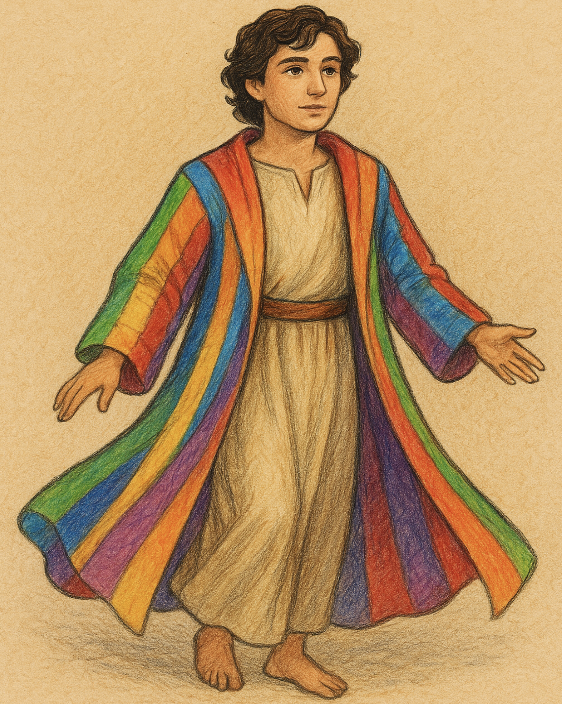
| Joseph’s coat of many colors has become the stuff of art, parenting books, spiritual seeking and a now-timeless Broadway musical. And wow, is it loaded! Perhaps Joseph’s coat became such a Biblical icon precisely because it is so loaded. Stitched into its amazing technicolor weave is a deep teaching about how we make meaning in our lives – and the stories we tell about what happens. In the process, this essentially human (and Jewish) project can’t help but play a time-traveling trick on us that hides in plain sight. It’s worth revealing that hidden story (with bonus content from “The West Wing”). |
By Rabbi David Evan Markus
Vayeishev 5786 (2025)Of something that looms so large in collective spiritual consciousness, Torah tells us very little – almost nothing, really. Yet it was enough to alter the course of history (Genesis 37:3-4):
| וְיִשְׂרָאֵ֗ל אָהַ֤ב אֶת־יוֹסֵף֙ מִכָּל־בָּנָ֔יו כִּֽי־בֶן־זְקֻנִ֥ים ה֖וּא ל֑וֹ וְעָ֥שָׂה ל֖וֹ כְּתֹ֥נֶת פַּסִּֽים׃ וַיִּרְא֣וּ אֶחָ֗יו כִּֽי־אֹת֞וֹ אָהַ֤ב אֲבִיהֶם֙ מִכָּל־אֶחָ֔יו וַֽיִּשְׂנְא֖וּ אֹת֑וֹ וְלֹ֥א יָכְל֖וּ דַּבְּר֥וֹ לְשָׁלֹֽם׃ | Israel loved Joseph more than all his sons, for he was the son of his old age, and made him an ornamental tunic. His brothers saw that their father loved him more than all his brothers: they hated him and could not say a peaceful word to him. |
Joseph’s coat epitomized special treatment, and it partly explains his brothers hating him, attacking him, conspiring to kill him and instead selling him to passersby heading to Egypt.
In Torah’s plot, it had to happen somehow. Joseph had to land in Egypt, so his family could follow, so a new Pharaoh who “knew not Joseph” could enslave their descendants. Only then could a Moses arise. Without Joseph’s coat, there’d be no liberation, no exodus, no Ten Commandments, no Torah, no Judaism, no Western monotheism, and no “us.”
Of course, we know all that only in hindsight, because (at least, spiritually speaking) it already happened. From where we are now, we can trace back a line of causation, step by step. From where we are now, it all lines up.
Our rabbinic ancestors also knew that Joseph’s pivotal moment aligned only in hindsight, so they weaved into Joseph’s coat all kinds of explanations for the coat – which they saw as the start of it all. Some held that the coat proved Joseph’s fated greatness as future vizier of Egypt. Others held that the coat was only to comfort a young Joseph whose mother (Rachel) had just died. Some imagined that Joseph was obligated to wear a coat because he tended his elderly father and such was the custom.
Others saw the coat as a parental warning never play favorites, no matter what good might arise.My favorite explanation is from 13th century French rabbi Hezekiah ben Manoah, who wrote that Joseph’s coat was called “ornamental” (in Hebrew, passim) only “in hindsight,” reflecting that Hebrew’s four letters for passim are an anagram for the four places Joseph was sold en route to Egypt. By Hezekiah’s day, the anagram story was 1,000 years old (Gen. Rabbah 84:8): It took Hezekiah to get that the meaning was retrospective – “in hindsight,” after the fact.
We make meaning after the fact. There’s no other way: meaning is 20/20 hindsight. For instance, after we come through a tough situation, we can look back and see how far we’ve come, what we learned, what we overcame, what part of ourselves needed work, and what part perhaps still does. The tough situation in our past takes on meaning by our experience during and after, then looking back.
And because we tend to know ourselves, for the most part this kind of hindsight “works.”
The problem is when our explanations depend on others whom, by definition, we know less well than our own selves,
when we look back with a judgmental edge, when maybe we have a vested interest in seeing things a certain way (perhaps to defend ourselves or our self-image). For instance, after a tough encounter with someone, if tough feelings linger, we are prone to tell ourselves stories such as, “She only did that because [unflattering critique].” Or, “He wasn’t responding to anything *I* said or did: he was just acting out.”
When it comes to others, the meaning we make tends to privilege our self-perceived rightness, our superiority, our innocence, our personal justifications.
As historians tell us, though, hindsight thinking that depends on others often are wrong. It’s a logical fallacy that if something happened after a thing beyond our full control, therefore it happened because of it. This logical fallacy is common enough in human life to earn it a Latin title: post hoc ergo propter hoc. This kind of backards thinking how folks tend to make meaning: it’s so natural, seamless and subconscious that we don’t even know we’re doing it.
Backwards meaning-making impulses play a game on us and often lead us astray. Our commentator Hezekiah’s brilliance was to see this fallacy for what it was, in real time – a product of mere hindsight thinking.
We do well to check our own thinking – and the meaning we create – whenthey depend on the amazing technicolor stories we tell ourselves about ourselves when others are concerned, and even more when the stories we tell ourselves are about others. Odds are good that some of those stories trip us up and deprive us of full truth and spiritual meaning.
And to commemorate The West Wing returning to Netflix this week, here’s a relevant clip from the first-season episode, suitably named “Post Hoc Ergo Propter Hoc”:
 David Evan Markus