Why do we believe or not believe? Why do our beliefs change? There are countless reasons. You have yours.
One reason, I’ve come to sense, is how religious and spiritual concepts are conveyed – which, for most of us, requires translation from Hebrew.
The thing is, translations aren’t value-neutral, which can tilt much of what we learn and come to understand. Over the centuries, it can make a huge difference spiritually.
Come see how it can impact what we hold most dear or keep furthest at bay.
By Rabbi David Evan Markus
Shemini 5786 (2026)
For nearly all of us, belief and disbelief evolve. Theology isn’t static but can shift as life does – how we’re raised, what we learn, who influences us, what happens to us, and what happens to people around us.
I’ve seen the most ardently faithful lose God and/or spirituality, the most ardent atheist find God and/or spirituality, and most everything in between. And it’s all quite normal.
There are many reasons why: you probably have your own. One reason, I’ve come to sense, is how we lay down tracks of concept and philosophy. Torah is part of that and, for Jews whose first language isn’t Hebrew, the translation of Torah is part of that. Which gets interesting.
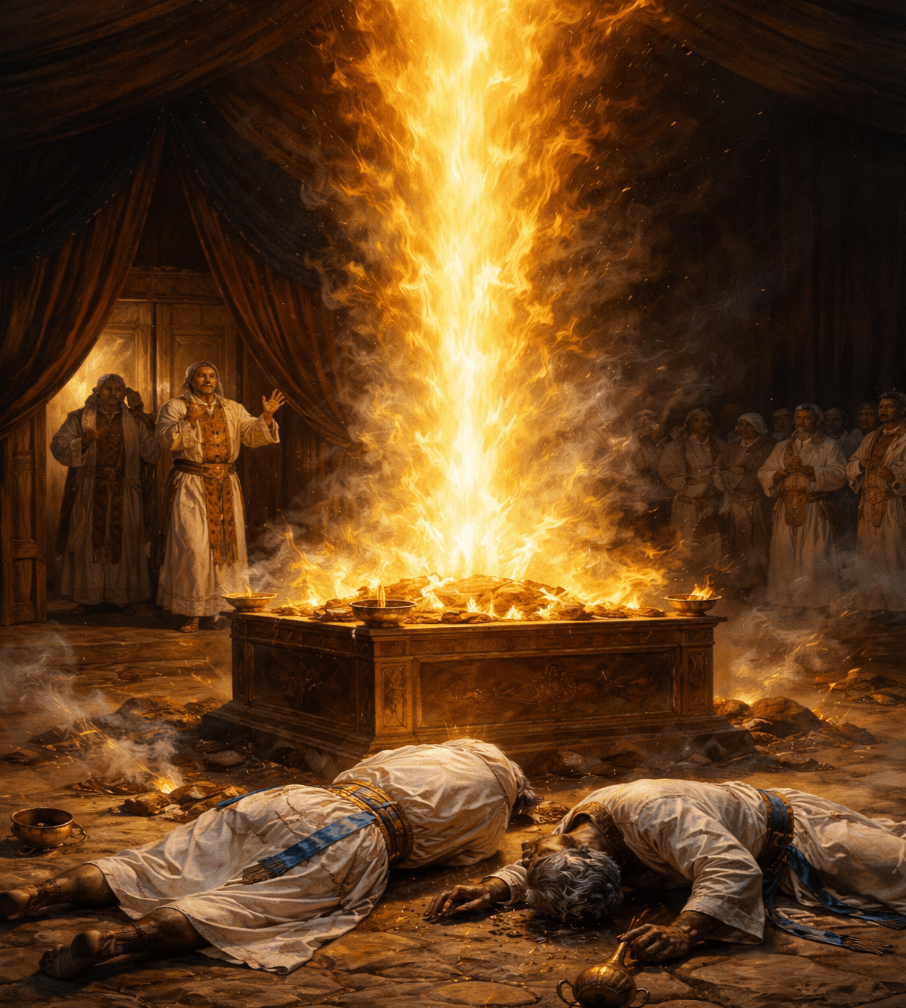
This week’s Torah portion is “Exhibit A.” In one of Torah’s difficult narratives, the sons of Aaron (Nadav and Avihu) bring to the altar a “strange fire” not commanded them. In Leviticus 10:2, they are consumed by fire.
Where did this consuming fire come from? The answer depends on which translation we use – and the answer matters greatly to what we make of the God of Torah.
The JPS translation says, “Fire came forth from God and consumed them; thus they died by God’s will.” In this translation, God sent the fire, and God wanted their death: God killed them.
Is the God of Torah angry and retributive, even murderous? Is this the God of Judaism? If Torah’s God is punitive, then does God also let innocent children have leukemia? Why did God not stop the car crash? the war? How many of us have lost or distanced God, faith or spirituality because God seems capricious or uncaring? because life hurts?
Such questions lurk in most every human heart. They are the stuff of moral reckoning and deep yearning for a world that is safe, righteous and just. These questions and countless variants are about theodicy, the philosophical conundrum of how an ostensibly all-knowing and all-powerful God can exist when bad things happen to good people. By definition, we cannot fully answer: the finite (including us) never can fully get the infinite (including God).
Therefore theodicy drives changes in faith and belief. And what we learn, and how we learn, can be jet fuel for it all. An angry, retributive God – or an uncaring God – would do the trick.
But wait! The Metzudah translation and Aramaic translation (<100 CE) both are very different: “A fire came forth from before [God] and consumed them, and they died in the presence of [God].” Not “from God” or “by God’s will” at all! These translations evoke a tragic accident that killed Nadav and Avihu, in which God was present but not the cause. What does it mean for God to be present when someone hurts and dies? That’s a very different question, and conjures a very different set of emotions and experiences.
Here’s another translation: “When the heavenly fire descended from the Eternal to burn the[ir] sacrifices, it consumed their souls, but their bodies were untouched; and they died in the Divine House of the Eternal.” This translation is ambiguous about causation but evokes a spiritual experience in God’s “House.” What is spiritual experience in God’s “House”?
Torah’s pure original Hebrew is most like the second translation: fire came forth “from before” God, who was present. The other translations draw from midrash, our people’s unending effort to story-tell our way toward understanding and making meaning in a world that often defies explanation.
Where do you find yourself in this essential journey? Drop me a line: I’m here for it all.
 David Evan Markus